
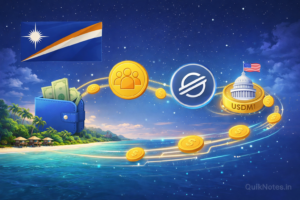
The Republic of the Marshall Islands has carried out what government and industry sources say is the world’s first national universal basic income (UBI) disbursement delivered on-chain, using a sovereign digital bond called USDM1issued on the Stellar blockchain and distributed through a government wallet called Lomalo. The program — financed from a national trust and backed by short-dated U.S. Treasuries — began disbursing payments in late November, with the on-chain mechanism used for the first round of digital transfers.
How the program works
According to the Marshall Islands finance ministry and reporting by blockchain outlets, the UBI program gives residents multiple options to receive their quarterly payments — bank transfer, paper cheque, or via the Lomalo digital wallet that can hold USDM1, a dollar-pegged sovereign token tied to short-term U.S. Treasury assets. The Marshall Islands describes the trust that funds the payments as seeded by proceeds tied to historic U.S. compensation arrangements and additional U.S. transfers through 2027.
USDM1 was structured as a digitally native sovereign instrument: each unit is reportedly issued against high-quality short-term Treasury instruments held in trust, and the token is recorded and transferred on Stellar so that disbursements can be executed and audited on-chain. The government says on-chain delivery was chosen to reach residents across hundreds of dispersed islands and to increase traceability of transfers.
Why officials pursued an on-chain approach
Marshall Islands officials and public statements cited the country’s geography and banking frictions as key motivations — distributing small, regular payments across remote atolls is logistically difficult and costly using only traditional rails. The digital option is intended to improve reach, reduce frictions, and provide instant settlement where internet and device access allow. Observers say the move is a high-profile example of “digital public finance” and a test case for sovereign use of tokenized real-world assets.
Reactions and risks
Reactions to the rollout have been mixed. International commentators and some tech advocates hailed the experiment as innovative and instructive for other small or remote jurisdictions that struggle with financial inclusion. But the move has also drawn warnings from international institutions: the IMF and some policy analysts have previously cautioned about sovereign stablecoins and tokenized liabilities, flagging risks such as monetary policy complications, legal and creditor considerations, and operational vulnerabilities in low-connectivity environments. The IMF and others urged careful safeguards — concerns echoed in coverage of the Marshall Islands program.
Industry partners named in coverage — including the Stellar Development Foundation and Crossmint — said they supported technical implementation, custody and distribution tooling for the Lomalo wallet and the USDM1 issuance. Several crypto-industry outlets reported that a portion of issuance is explicitly backed by short-dated U.S. Treasuries to preserve capital and provide redemption certainty.
What to watch next
- Adoption and access: How many Marshall Islands residents choose the digital wallet option versus traditional payment channels, and whether connectivity limits uptake in remote atolls.
- Redemption and stability: How USDM1 redemptions work in practice and whether the trust’s Treasury backing is maintained transparently.
- Policy and precedent: Whether other small states or jurisdictions follow the Marshall Islands’ model for social transfers or sovereign RWA (real-world asset) tokenization.
- Regulatory pushback: Possible follow-up from multilateral bodies (IMF, World Bank) and how global regulators react to a sovereign token used for social policy.
Reporting note: This article synthesizes reporting from the Marshall Islands finance ministry and coverage in major outlets, including The Guardian, CoinDesk and government materials on the USDM1 framework and Lomalo wallet. Key claims about on-chain disbursement, USDM1’s Treasury backing and the use of Stellar for distribution are drawn from those sources.
Also Check: Visa to offer stablecoin settlement for U.S. institutions using Circle’s USDC on Solana
6KKE9VRB

