
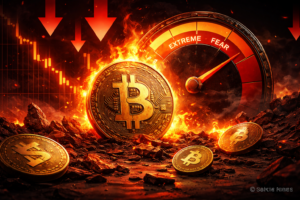
Market Sentiment Turns Sharply Negative: The widely followed Crypto Fear and Greed Index, a key barometer of investor sentiment in digital assets, has plunged to a reading of 9, marking the lowest point in market psychology since the infamous Terra (Luna) crash in mid-2022. The dramatic slide into “extreme fear” underscores widespread anxiety among traders and holders as crypto prices continue to face downward pressure.
What the Index Shows
The Crypto Fear and Greed Index is a sentiment gauge that scores market mood on a scale of 0 to 100 — with 0 indicating extreme fear and 100 indicating extreme greed. It aggregates multiple data inputs including price volatility, trading volume, social media sentiment, market momentum, and Bitcoin dominance to quantify investor behavior.
A score of 9 indicates deep pessimism, with investors overwhelmingly nervous about further declines and riskier assets being sold off. This is one of the most stressed readings observed in recent years, rivaled only by severe drawdowns such as the one during the Luna collapse.
Market Conditions Driving Extreme Fear
Several factors are contributing to the sentiment collapse:
1. Large Liquidations and Price Declines:
Recent volatility wiped out roughly $2.7 billion in leveraged positions over 24 hours, intensifying selling pressure. Bitcoin, the bellwether crypto, dipped sharply at times toward key support levels before modestly rebounding.
2. Broader Sell-Off:
Traders are retreating to safer assets amid declining confidence — a pattern consistent with the extreme fear reading. The broader crypto market cap has seen significant contraction as altcoins and high-beta tokens slump alongside Bitcoin.
3. Macro and Regulatory Headwinds:
Concerns around tighter regulation, global macro uncertainty, and slower inflows into digital assets have fed into risk-off behavior from both retail and institutional participants. These pressures amplify caution and reduce appetite for fresh exposure.
Historical Context: Terra Crash Comparison
The last time the Fear and Greed Index was at such a low level was in the aftermath of the Terra (Luna) collapse in 2022, one of the most significant stress events in crypto history. That episode saw cascading liquidations across markets and a widespread loss of investor trust in algorithmic stablecoins — effects still referenced in sentiment analysis today.
Industry analysts view comparisons to past extreme fear periods as important benchmarks for risk management and potential contrarian entry points, although cautioning that sentiment extremes alone are not timing tools.
What This Could Mean for Investors
Contrarian Signals:
Historically, readings in extreme fear zones have occasionally preceded market rebounds, as selling exhaustion can form short-term bottoms. Some long-term holders and contrarian investors interpret such sentiment lows as buying opportunities — though this strategy carries significant risk and depends on broader market trends.
Market Uncertainty Remains High:
Despite occasional spikes in sentiment or short-lived relief rallies, the low fear and greed score indicates persistent caution, with many participants opting to reduce exposure or remain on the sidelines until clearer signals emerge.
Conclusion
The recent plunge of the Crypto Fear and Greed Index to 9 highlights an exceptionally bearish mood across the cryptocurrency ecosystem — the deepest “extreme fear” reading in years. Whether this signals a capitulation point or continued volatility will depend on forthcoming price action, macro developments, and investor responses. However, traders and analysts alike will be monitoring these sentiment extremes closely as part of broader market analysis.
Also Check: South Korea’s Financial Supervisory Service Probes ZK Token’s 1000% Price Surge on Upbit
SCIMAYA1

