
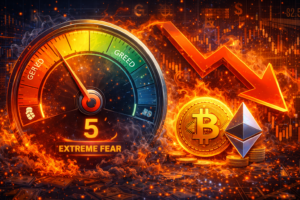
Market sentiment in the cryptocurrency sector plunged sharply this week as the Crypto Fear and Greed Index — a widely followed gauge of investor emotion — collapsed to 5, signaling “Extreme Fear” among market participants. This reading came after the index had already slid to 11 just days earlier, reflecting intensifying bearish sentiment and heavy selling pressure across major digital assets.
The Fear and Greed Index — which ranges from 0 to 100, with lower numbers indicating heightened fear and higher numbers suggesting optimism or complacency — moved decisively into record low territory as traders reacted to sharp price declines and broader market stress.
What the Extreme Fear Reading Means
A reading of 5 places the index deep within the Extreme Fear zone (0-24), a classification indicating pervasive pessimism among buyers and sellers, often driven by sustained price drops, elevated volatility, and negative sentiment indicators. According to sentiment tools, such low scores are historically associated with panic selling and widespread risk aversion.
Some analysts and traders view such extreme fear conditions as contrarian signals — moments when excessive pessimism could create buying opportunities for long-term investors — while others caution that low sentiment can persist for weeks or longer during protracted market downturns.
Market Drivers Behind the Sentiment Plunge
The sharp drop in sentiment has coincided with a broad sell-off in major cryptocurrencies. Bitcoin briefly dipped below key support levels and overall market capitalization declined, reinforcing risk-off behavior among traders.
Liquidation events have also contributed to negative sentiment. Some reports noted that over $1 billion in crypto positions were liquidated during recent price moves, amplifying downward pressure on prices and triggering sharper risk aversion.
Historical Context and Investor Takeaways
The Fear and Greed Index’s extreme readings are not unprecedented, but reaching levels as low as 5 remains rare and usually reflects a high degree of uncertainty among market participants. For many, this suggests markets are dominated by selling interest and a lack of fresh capital entering risk assets.
Historically, some investors have interpreted extreme fear phases as potential buying zones, arguing that once sentiment bottoms, it may precede a rebound. However, such strategies carry risk, especially if broader economic factors continue to weigh on crypto prices.
What the Index Tracks
The Crypto Fear and Greed Index aggregates multiple factors — including price volatility, trading volume, social media sentiment, market momentum, and search trends — to compute a daily score that reflects market psychology. Lower values typically arise from higher volatility, declining volume, and negative social sentiment, all signs of bearish conditions.
Also Check: Danske Bank Opens Crypto Investment Access With Bitcoin & Ethereum ETPs, Ending Long-Standing Ban
UJKX2MWP

