
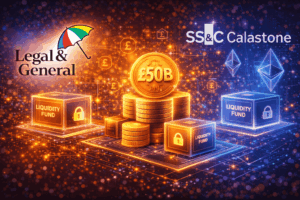
Legal & General Asset Management has made its £50 billion suite of liquidity funds available in tokenized formthrough the Calastone Tokenised Distribution Network, marking a major step in the adoption of blockchain technology within traditional asset management.
The move reflects growing institutional interest in tokenization as a way to modernize fund distribution and improve efficiency across financial markets.
Bringing Traditional Funds Onto Blockchain Infrastructure
The tokenized liquidity funds are now accessible via blockchain-enabled systems, allowing investors to buy, hold, and transfer fund units digitally within a regulated environment.
Calastone, part of SS&C Technologies, provides the infrastructure supporting:
- Token creation
- Order routing
- Trade aggregation
- Reconciliation and on-chain settlement
The system is designed to integrate seamlessly with existing fund administration processes, allowing tokenization without disrupting traditional investment channels.
£50 Billion in Liquidity Funds Goes Digital
The initiative covers more than £50 billion in liquidity assets, including funds denominated in U.S. dollars, euros, and British pounds.
Liquidity funds are typically used by institutional investors for:
- Capital preservation
- Same-day settlement
- Short-term yield generation
By offering these funds in tokenized form, Legal & General aims to expand access to new digital investor segmentswhile maintaining the same underlying investment strategies.
Tokenization Focused on Distribution Efficiency
Unlike some blockchain initiatives that create entirely new financial products, this approach focuses on tokenizing existing fund structures.
The Calastone network connects traditional fund infrastructure with digital distribution channels, enabling:
- Faster settlement processes
- Improved operational efficiency
- Broader global accessibility
Tokenized fund units are issued within a permissioned framework, meaning only authorized participants can transact—an important feature for regulatory compliance.
Built on Ethereum and EVM-Compatible Networks
Initially, the tokenized funds are being deployed on Ethereum and other EVM-compatible blockchains, with plans to expand to additional networks over time.
This multi-chain approach reflects the growing demand for interoperability in digital asset infrastructure.
Institutional Adoption of Tokenization Accelerates
The move by Legal & General highlights a broader trend of large asset managers exploring tokenization as a practical solution for modernizing financial systems.
Industry experts note that tokenization is increasingly being applied to:
- Money market and liquidity funds
- Bonds and fixed-income products
- Real-world assets (RWAs)
Rather than replacing existing systems, many firms are adopting hybrid models that combine blockchain technology with traditional financial infrastructure.
Industry Perspective
Executives involved in the project emphasized that tokenization is no longer experimental but is moving into real-world production environments.
The launch demonstrates how established financial products can be adapted to digital channels without requiring major operational overhauls.
Outlook
Legal & General’s tokenized liquidity fund rollout represents a significant milestone in the evolution of asset management.
As more institutions explore blockchain-based distribution, tokenization is expected to play a growing role in:
- Expanding investor access
- Reducing operational friction
- Enhancing settlement efficiency
For now, the development signals a clear shift: tokenization is moving from concept to large-scale institutional deployment.
Disclaimer: This article is for informational purposes only and does not constitute financial or investment advice.
Also Check: Alibaba Launches “Happy Oyster” AI Model for 3D Interactive Video Creation Across Games and Film
6X3XUT3C

