
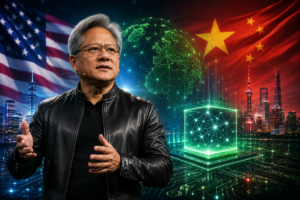
Nvidia CEO Jensen Huang has argued that the United States should not ban Chinese open-source artificial intelligence models, saying that keeping them accessible would better serve innovation, competition, and even U.S. national security.
Speaking in an interview with Axios, Huang pushed back against calls in Washington to restrict Chinese AI models amid growing concerns over China’s rapid advances in generative AI. His comments come as policymakers debate whether Chinese open-source models pose strategic and cybersecurity risks to the United States.
Huang: Open AI Should Be Embraced, Not Blocked
Huang said there is “zero possibility” that Chinese open-source AI models will drive American AI companies out of business. Instead, he argued that developers and researchers should be free to study and build upon models regardless of where they originate.
According to Huang, banning foreign open-source AI would slow technological progress while limiting opportunities for American developers to understand and improve competing systems.
AI Development Is a Global Learning Process
During the interview, Huang emphasized that artificial intelligence advances through shared research and iterative improvements.
He argued that AI developers routinely learn from existing models through benchmarking, experimentation, and optimization, describing this process as a natural part of technological innovation rather than a threat in itself.
Huang suggested that restricting access to open models could reduce transparency and make it harder for researchers to evaluate emerging AI capabilities from around the world.
Comments Come Amid Rising Concerns Over Chinese AI
The debate intensified following the emergence of powerful Chinese AI models, including Moonshot AI’s Kimi K3, which has drawn attention for performance levels that some analysts believe rival leading U.S. systems.
Several American AI companies and government officials have expressed concern that Chinese firms may have benefited from intellectual property developed by U.S. labs through techniques such as model distillation.
Those concerns have prompted discussions about possible sanctions and broader restrictions on certain Chinese AI technologies.
Differing Views Within the AI Industry
Huang’s position contrasts with that of some U.S. AI companies that have advocated tighter controls on Chinese AI development.
Some executives argue that restricting access to advanced foreign AI models is necessary to protect U.S. intellectual property and maintain America’s technological advantage.
Huang, however, believes open competition ultimately strengthens U.S. innovation and encourages domestic companies to build better products rather than relying on regulatory barriers.
Nvidia’s Broader Position on AI Competition
Nvidia has consistently argued that maintaining global participation in AI ecosystems benefits the United States over the long term.
While Huang has supported keeping America’s most advanced AI hardware ahead of international competitors, he has also repeatedly cautioned that excessive restrictions on AI technologies could accelerate the development of alternative ecosystems outside U.S. influence.
Open-Source AI vs. National Security
The discussion reflects a broader policy debate over balancing technological openness with national security.
Supporters of tighter controls argue that unrestricted access to advanced AI models could:
- Increase cybersecurity risks.
- Accelerate foreign military AI capabilities.
- Enable intellectual property misuse.
- Reduce America’s competitive advantage.
Supporters of open-source AI counter that transparency allows researchers to identify vulnerabilities, improve model safety, and accelerate innovation through collaboration. Huang’s comments align with this latter view, emphasizing openness as a strategic advantage rather than a weakness.
What It Means for the AI Industry
Huang’s remarks come at a pivotal moment as governments worldwide consider new regulations governing advanced AI systems.
With Chinese AI models becoming increasingly competitive and U.S. policymakers weighing additional restrictions, Nvidia’s CEO has positioned the company as a prominent advocate for open AI development and international technological collaboration.
Whether regulators ultimately adopt tighter controls or maintain broader access, the debate is expected to shape the future of global AI competition for years to come.
Also Check: Lummis Says CLARITY Act Would Protect Customer Assets After Terra’s $40B Collapse
8P13ELV2

