
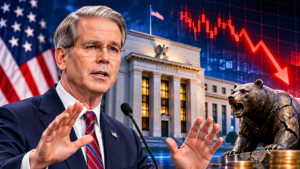
U.S. Treasury Secretary Scott Bessent has warned that the Federal Reserve risks making a policy mistake if it raises interest rates too aggressively in response to persistent inflation, arguing that tighter financial conditions are already putting pressure on the U.S. economy.
Speaking on CBS’s Face the Nation on Sunday, November 22, Bessent said the central bank should be careful not to overtighten monetary policy as financial markets experience renewed volatility. His comments come as investors assess the possibility of another interest rate increase at the Federal Reserve’s December meeting.
“Many people believe that they may be making a policy mistake if they overtighten,” Bessent said, according to Bloomberg. He added that financial conditions had tightened substantially over the preceding months.
The warning highlights a growing disagreement over the appropriate response to inflation. While Bessent has argued that some recent price pressures are linked to temporary energy supply disruptions, several Fed officials believe inflation remains persistent enough to justify further monetary tightening.
Bessent Says Aggressive Fed Rate Hikes Could Hurt the Economy
Bessent’s latest comments reflect his concern that the Federal Reserve could weaken economic activity by raising borrowing costs too sharply when financial conditions are already becoming more restrictive.
Higher interest rates generally increase the cost of borrowing for households and businesses. They can make mortgages, business loans and corporate financing more expensive, potentially slowing consumer spending, investment and hiring.
However, the Treasury secretary’s concern extends beyond the direct effect of interest rates. When stock prices fall, bond yields rise and credit becomes more expensive, financial conditions can tighten even without an additional move by the Federal Reserve.
Bessent’s argument is that policymakers should account for these broader market developments before deciding whether further rate increases are necessary.
His remarks do not mean the Treasury Department determines interest-rate policy. The Federal Reserve operates independently and makes monetary policy decisions through the Federal Open Market Committee (FOMC).
October Inflation Data Complicates the Federal Reserve’s Decision
The latest inflation figures have strengthened the case for caution among investors while also giving hawkish Fed officials reasons to consider additional rate increases.
According to the U.S. Bureau of Labor Statistics, the Consumer Price Index (CPI) increased 0.4% in October 2026, following a 0.6% rise in September. Economists surveyed by Reuters had expected a smaller monthly increase of 0.3%.
Core CPI, which excludes food and energy prices, increased 0.3% in October for the third consecutive month. Economists had expected a 0.2% rise.
The report also showed increases in shelter, food and energy costs. Shelter prices rose 0.3%, while the food index increased 0.5% and the energy index advanced 0.7%.
The BLS did not publish the usual October year-over-year inflation figures because the 2025 federal government shutdown prevented the collection of price data for October last year.
These figures present a challenge for the Federal Reserve. Inflation remains above its 2% target, but policymakers must also consider whether the recent price increases reflect temporary supply-side pressures or broader demand-driven inflation.
Fed Officials Remain Divided Over Further Interest Rate Increases
The Federal Reserve maintained its benchmark interest-rate range at 3.75% to 4.00% during its October 27–28 meeting.
However, the meeting minutes released in November revealed significant concern among policymakers about the inflation outlook.
According to the minutes, almost all participants believed further rate increases could be necessary if the economy developed as expected. A couple of policymakers also suggested that a larger, half-percentage-point increase might be required if incoming inflation data remained unfavorable.
Two officials, Lisa Cook and Beth Hammack, dissented from the October decision and preferred a quarter-percentage-point increase.
The disagreement suggests that the December 8–9 meeting could involve a difficult debate over whether the central bank should raise rates, maintain its current position or signal a more restrictive policy outlook.
Bessent’s warning adds another perspective to that debate, particularly concerning the risk that aggressive monetary tightening could intensify existing financial-market pressures.
Bessent and Fed Officials Disagree Over the Source of Inflation
Bessent has previously argued that the Federal Reserve should distinguish between temporary energy-driven inflation and persistent price increases across the broader economy.
On November 13, he said the central bank should not raise interest rates excessively in response to an energy supply shock associated with the Iran conflict. He argued that oil-related price pressures could ease and that monetary policy should look ahead rather than react too strongly to temporary data.
Chicago Fed President Austan Goolsbee offered a different assessment in comments reported by Reuters.
Goolsbee said inflation pressures had extended beyond energy prices into services and medical care. He also pointed to demand associated with the expansion of artificial intelligence data centres as a potential source of additional inflationary pressure.
The disagreement reflects a central challenge for monetary policymakers: determining whether inflation is likely to decline as supply disruptions ease or whether broader price pressures require a more restrictive interest-rate policy.
US Stock Market Correction Adds to Concerns About Financial Conditions
Bessent’s warning comes during a period of heightened volatility in U.S. financial markets.
Reuters reported on November 22 that the S&P 500 had fallen 11.6% from its October 6 record high, placing the benchmark index in correction territory. The index had also recorded seven consecutive sessions of declines, its longest losing streak since the beginning of the COVID-19 pandemic in 2020.
The technology-heavy Nasdaq Composite had erased its gains for 2026 and was down 2.7% for the year as of Friday’s close.
Market volatility also increased sharply. The Cboe Volatility Index (VIX), commonly known as Wall Street’s fear gauge, closed at 35.89 on Friday, its highest level since the market turmoil of April 2025.
Investors have been reassessing the sustainability of heavy artificial intelligence investment, particularly spending on data centres. Concerns about valuations, future earnings and the possibility of additional Federal Reserve rate increases have added to selling pressure.
The market correction does not necessarily mean the U.S. economy is entering a recession. However, it demonstrates how quickly investor confidence can weaken when concerns about valuations, borrowing costs and economic growth converge.
December Fed Meeting Becomes a Key Market Event
The Federal Reserve’s December 8–9 meeting is likely to be an important event for financial markets.
Investors will be watching whether policymakers decide to increase interest rates again and how they describe the future direction of monetary policy.
A further increase could help address persistent inflation but may also raise borrowing costs and put additional pressure on businesses, consumers and financial markets.
On the other hand, holding rates steady could provide some relief to borrowers and investors, but it may also create concerns that the central bank is not responding forcefully enough to inflation.
The balance between controlling inflation and avoiding unnecessary economic damage will remain central to the Fed’s decision.
Bottom Line
Scott Bessent’s warning highlights the growing tension between inflation control and financial stability in the United States. While recent CPI data and hawkish comments from Fed officials have strengthened expectations of further monetary tightening, the ongoing stock market correction suggests that financial conditions are already under pressure.
The Federal Reserve must now weigh the risk of allowing inflation to remain elevated against the possibility that excessive tightening could weaken economic growth. Its December meeting will provide an important indication of how policymakers intend to manage that balance.
Disclaimer: This article is for informational purposes only and does not constitute financial or investment advice. Economic data, Federal Reserve decisions and market conditions can change.
Also Check: FBI Investigates Possible Breach of National Crime Database After USDA Farmer Payment System Hack

