
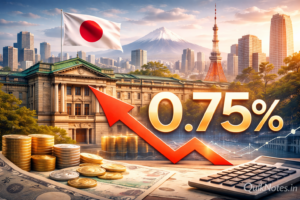
The Bank of Japan (BoJ) has raised its key policy interest rate by 0.25 percentage points to 0.75%, marking the highest level in 30 years as of December 19, 2025. The decision — made unanimously by the BoJ’s policy board — reflects a continued shift away from decades of near-zero interest rate policy amid persistent inflation and improving economic indicators.
Historic Rate Hike and Policy Change
In its latest monetary policy meeting, the Bank of Japan increased its benchmark interest rate from 0.50% to 0.75%, a level not seen since September 1995. The unanimous decision, announced by Governor Kazuo Ueda, underscores the central bank’s commitment to normalising monetary policy after years of ultra-loose conditions aimed at combating deflation.
Governor Ueda, who has led the BoJ since April 2023, has overseen several tightening steps as inflation in Japan has remained above the bank’s 2% target for an extended period — a significant departure from decades of sub-target price growth.
Why the BoJ Shifted Policy
Several key economic trends influenced the policy shift:
- Persistent Inflation: Core consumer prices in Japan have remained above the central bank’s inflation goal for months, driven in part by higher import costs, food prices, and wage pressures.
- Improved Business Sentiment: Surveys of Japanese manufacturers and firms show rising confidence, supporting the case for tighter monetary conditions.
- Global Monetary Context: While other major central banks have eased or kept rates steady amid global economic uncertainty, the BoJ’s stance reflects a distinct inflation and economic dynamic in Japan.
The policy rate increase comes at a time when Japan’s economy has faced mixed signals — including weak overall growth alongside pockets of wage and price strength — prompting policymakers to balance inflation control with economic resilience.
Market and Currency Impact
The rate hike has already influenced financial markets:
- Yen Movements: Despite the tightening, the Japanese yen has struggled to gain significantly, remaining under pressure against the U.S. dollar — a situation analysts attribute to long-standing structural and fiscal challenges in the Japanese economy.
- Global Markets: Financial markets are closely watching potential follow-on effects, including shifts in government bond yields and cross-border investment flows, particularly as Japan remains one of the world’s largest capital exporters.
Investors are also assessing how the end of ultra-low rates might reshape strategies such as the yen carry trade, where cheap borrowing costs in Japan historically supported global investment patterns.
Economic Outlook and Future Moves
Analysts expect that the BoJ’s move could signal a longer-term normalization path with additional interest rate adjustments if inflation and wage trends sustain. Policymakers have indicated their readiness to act depending on forthcoming economic data.
However, with Japan’s economy still grappling with structural issues — including an ageing population and fiscal constraints — the pace and magnitude of future monetary tightening remain subjects of debate among economists.
Bottom Line
The Bank of Japan’s decision to raise its key policy rate to 0.75% marks a watershed moment in the nation’s monetary history — the highest level in three decades. This shift reflects evolving inflation dynamics and marks a departure from long-standing accommodative policy. Markets and policymakers alike will closely watch how the move influences Japan’s economy and global financial conditions in 2026 and beyond.
Also Check: Bank of England Cuts Interest Rate by 25 bps to 3.75%
N7VRIQ5Z

