

The U.S. Commodity Futures Trading Commission (CFTC) has updated its guidance on stablecoins, explicitly allowing national trust banks to issue U.S. dollar-pegged tokens under the federal Guiding and Establishing National Innovation for U.S. Stablecoins (GENIUS) Act regulatory framework — a move expected to boost institutional participation in the digital asset ecosystem.
Expanded Stablecoin Issuance Criteria
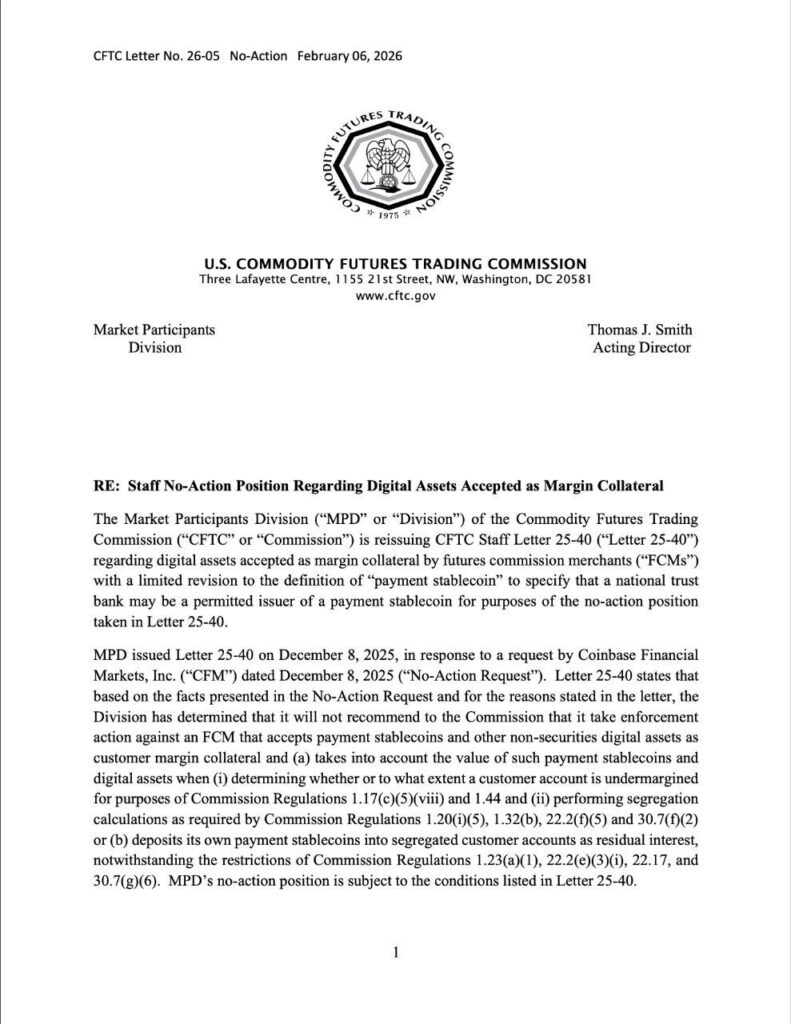
On Feb. 6, 2026, the CFTC’s Market Participants Division reissued Staff Letter 25-40, the agency’s no-action letter on payment stablecoin collateral, with a significant revision: it now explicitly includes national trust banks as eligible issuers of payment stablecoins. Previously, the letter had focused on tokens from state-regulated money transmitters and trust companies, inadvertently excluding nationally chartered institutions.
Under the updated guidance, stablecoins issued by national trust banks can qualify as payment stablecoins and may be used as acceptable collateral in derivatives markets and other regulated settings, provided they meet the conditions set out under the letter and the GENIUS Act framework.
Regulatory Context: GENIUS Act Framework
The GENIUS Act, signed into law in July 2025, created the first comprehensive federal regulatory regime for U.S. dollar-pegged “payment stablecoins.” It establishes requirements for reserve backing, transparency, audit standards, risk-management and oversight by primary regulators, including the Office of the Comptroller of the Currency (OCC) and banking regulators. The law’s goal is to foster innovation while protecting consumers and ensuring financial stability.
By aligning its stablecoin definition with the GENIUS Act, the CFTC is seeking to ensure that federally chartered financial institutions — including national trust banks — can participate fully in the issuance of regulated digital tokens. This clarification removes uncertainty from the earlier version of Staff Letter 25-40 and reflects the evolving regulatory landscape for digital assets in the U.S.
Impacts on Markets and Institutions
National trust banks, which are federally chartered but typically offer custodial, fiduciary and asset management services rather than traditional retail lending, have increasingly sought clearer pathways to engage with digital asset issuance. The updated CFTC guidance now potentially allows stablecoins issued by these banks to serve as margin collateral for futures contracts or be recognized as payment tokens under regulatory safeguards, such as proof of full reserve backing and risk controls.
Industry analysts say this regulatory clarification could broaden institutional participation in stablecoin markets and strengthen the role of bank-issued tokens in traditional financial processes like derivatives trading and settlement, provided firms comply with reserve and reporting requirements.
Broader Regulatory Developments
This update by the CFTC is part of a wider federal push to clarify digital asset regulations in the United States. In addition to the GENIUS Act, regulators including the Federal Deposit Insurance Corporation (FDIC) and the Office of the Comptroller of the Currency (OCC) have outlined frameworks that allow U.S. banks to issue payment stablecoins through supervised entities, ensuring safety and soundness while integrating digital currencies into regulated financial systems.
Market observers view the CFTC’s action as an incremental but meaningful step toward mainstreaming stablecoins in regulated markets, demonstrating how digital tokens might operate alongside traditional financial instruments while maintaining compliance with federal law.
Looking Ahead
The CFTC’s clarified position does not automatically allow national trust banks to issue stablecoins immediately; issuers must still meet regulatory conditions, including adequate reserves, transparency and risk-management safeguards. Industry stakeholders will be watching to see how banks and other institutions move forward with this expanded eligibility and how the stablecoin market evolves under strengthened U.S. oversight.
ILLE72JE

