
Summary:
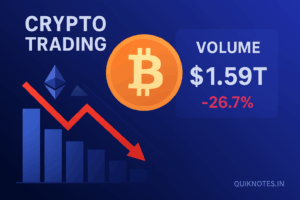
Global cryptocurrency exchange spot trading volume dropped to approximately US$1.59 trillion in November 2025, down 26.7% from October’s US$2.17 trillion — marking the lowest monthly volume since June this year. Centralized exchanges (CEXs) accounted for the bulk of the volume at about US$1.59 trillion, while decentralized exchange (DEX) volume also slid sharply, dropping approximately 30% month-over-month to an estimated US$397.8 billion.
What the Data Shows
- October recorded a record-high 2025 spot trading volume among exchanges: CEX volume hit US$2.17 trillion, while DEXs combined for about US$613.3 billion in monthly spot volume.
- In November, total spot trading volume — both centralized and decentralized — fell to ≈ US$1.59 trillion, representing a 26.7% drop from October. According to the data snapshot, CEX volume remained roughly US$1.59 trillion, and DEX volume dropped by roughly 30% to approx. US$397.8 billion (from October’s DEX total).
- The slump marks the lowest level of monthly global spot trading since June, highlighting a period of market cooldown and reduced trading activity as crypto prices remain under pressure.
Why Volume Fell
- Market downturn & volatility: Recent sharp declines in major tokens — including a steep drop in Bitcoin — have shaken investor confidence, prompting reduced trading and a large exodus from risk-on positions.
- Profit-taking & deleveraging: Many traders likely took profits or exited leveraged positions after volatile price swings, which tends to suppress volume once liquidation pressure eases.
- Reduced speculative activity: With fewer high-risk, high-reward opportunities and high market uncertainty, speculative trading — especially on altcoins — appears to have cooled substantially.
- Broader macroeconomic sentiment: Macro factors — such as global interest rate and economic conditions — may have dampened risk appetite, reducing inflows into crypto compared with previous months.
What It Means for Exchanges, Traders & Markets
- Liquidity stress: Lower volume can translate into thinner order books, wider spreads, and slippage for traders — especially for large orders on smaller tokens.
- Revenue pressure on exchanges: Spot trading fees are a major source of income for exchanges; a 27% volume drop could translate directly into lower revenue, putting pressure on profitability.
- Shift to derivatives or other crypto products: With spot volume down, traders may shift their activity to derivatives (futures, leveraged tokens), staking, or other yield-generating products — potentially shifting risk/interest concentrations.
- Volatility potential on rebound: Should market sentiment improve — e.g., due to news, regulation, or macro tailwinds — any rebound in volume may come with outsized volatility as liquidity rebuilds unevenly.
- Signal for institutional/investor caution: The slump may reflect an overall cooling off in market enthusiasm; institutional or long-term investors may interpret this as a sign to remain cautious, at least until volatility subsides.
What to Watch Next
- December volume and seasonality: Whether November’s drop is a temporary blip — perhaps seasonal — or the start of a longer-term downtrend.
- Derivatives & altcoin flows: Whether capital shifts from spot to futures, perpetuals, staking, or emerging crypto products, as spot markets struggle.
- Exchange quarterly earnings: How the drop impacts major centralized exchanges — fee-based revenues, custody growth, and user retention.
- Macro developments & price catalysts: Any major macroeconomic, regulatory, or crypto-specific catalysts that could trigger renewed buying and volume recovery.
- DEX resilience and on-chain activity: Whether DEXs — often perceived as more decentralized and resilient — bounce back sooner or show more stability than centralized platforms.
Bottom Line:
November’s steep decline in global spot-crypto trading volume — with both centralized and decentralized exchanges seeing major drops — underscores the fragility of the current crypto market under pressure from price volatility, macro uncertainty, and waning retail fervor. Liquidity, volatility, and exchange-revenue risks are rising, and the coming months will be critical to see whether the market can stabilize or remains subdued.
Also Check: China’s Central Bank Issues Fresh Warning — Virtual Assets Not Legal Tender, Stablecoins Deemed Risky
Z85HYEB9

