
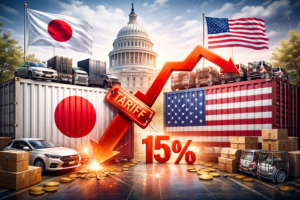
Japan has asked the United States to ensure that new tariff policies do not place Tokyo at a disadvantage, as Washington considers trade rules that could raise duties on Japanese goods to as much as 15%. The request reflects rising concerns among Japanese policymakers that the evolving U.S. tariff framework could increase costs for exporters and disrupt existing trade agreements between the two countries.
High-Level Trade Talks in Washington
The issue was raised by Japan’s Minister of Economy, Trade and Industry, Ryosei Akazawa, during a two-hour meeting in Washington with U.S. Commerce Secretary Howard Lutnick. Akazawa urged the United States to maintain fair treatment for Japanese imports as the U.S. government introduces new tariff measures.
According to Japanese officials, Tokyo wants assurances that the new tariffs will not leave Japan worse off than under previous bilateral trade arrangements. Discussions between the two sides also covered broader economic cooperation and upcoming investment projects.
Proposed Tariffs Could Reach 15%
The dispute comes amid changes to U.S. trade policy following legal challenges to earlier tariffs. The United States recently introduced a 10% blanket tariff on imports, which officials have said could be increased to 15% under revised rules.
The potential increase has created uncertainty among global exporters, including Japanese manufacturers. Key industries such as automobiles, electronics, and machinery rely heavily on exports to the United States, making them particularly sensitive to tariff changes.
Under a previous trade agreement, U.S. tariffs on Japanese auto imports were reduced from 27.5% to around 15%, and Japan is seeking to ensure the new policies do not reverse those gains.
Economic Partnership and Investment Commitments
The tariff issue is also linked to broader economic negotiations between the two countries. Japan has pledged approximately $550 billion in investments in the United States, aimed at strengthening industrial cooperation, energy development, and technology projects.
Officials say the investment program is designed to deepen economic ties while supporting U.S. manufacturing and infrastructure. Discussions during the Washington meeting also included cooperation in areas such as energy, critical minerals, and nuclear power development.
Global Trade Uncertainty
The dispute highlights broader uncertainty surrounding global trade policy. U.S. tariff decisions since 2025 have created volatility across international markets, prompting governments and companies to reassess supply chains and trade strategies.
Analysts note that even relatively small tariff increases can have significant effects on global commerce because they influence pricing, supply chains, and investment decisions.
Outlook
Japan and the United States are expected to continue discussions in the coming weeks to clarify the final structure of the new tariff rules. The outcome will determine whether Japanese exporters face higher costs or maintain favorable access to one of their most important overseas markets.
The issue may also feature prominently in upcoming diplomatic engagements between the two countries as they seek to balance domestic economic priorities with the long-standing U.S.–Japan trade partnership.
Also Check: Kazakhstan’s Central Bank Plans $350M Crypto-Linked Portfolio to Launch in April–May

