
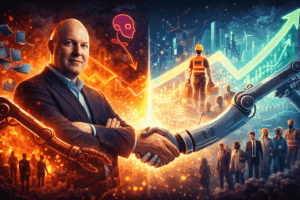
Venture capitalist Marc Andreessen has pushed back against growing concerns that artificial intelligence will lead to widespread unemployment, arguing that the narrative around “AI-driven job loss” is largely misleading.
Instead, the Andreessen Horowitz co-founder believes AI will trigger a major productivity boom, ultimately creating more jobs than it displaces.
“AI Job Loss” Narrative Called Misleading
Andreessen has criticized the idea that artificial intelligence is the primary driver behind recent layoffs, suggesting that companies are often using AI as a convenient explanation rather than the real cause.
Recent reports show that he described AI as a “silver bullet excuse” for layoffs, pointing instead to macroeconomic factors such as rising interest rates and overhiring during the pandemic as the main reasons behind job cuts.
This view challenges a widely circulating narrative that AI is already replacing large segments of the workforce.
AI as a Driver of Economic Growth
Andreessen’s stance is rooted in a broader belief that technological innovation historically creates more jobs than it destroys.
He argues that AI could arrive at a critical moment for the global economy, helping address:
- Slowing productivity growth
- Aging populations and shrinking workforces
- Structural economic stagnation
Rather than eliminating work, AI is expected to augment human capabilities and unlock new industries, similar to past technological revolutions.
Productivity Boom Could Reshape Labor Markets
According to Andreessen, the real impact of AI will be a surge in productivity that lowers costs, increases output, and expands economic activity.
Higher productivity could:
- Make goods and services cheaper
- Increase demand across industries
- Create entirely new job categories
This aligns with his long-standing “techno-optimist” philosophy, which sees technology as the primary engine of economic growth and human progress.
Debate Intensifies Across the Tech Industry
Andreessen’s comments come amid a broader debate within the tech sector about AI’s impact on jobs.
While some executives warn of large-scale disruption, others argue the transition will be more gradual and ultimately positive.
Recent industry discussions highlight:
- Rising layoffs in tech, sometimes attributed to AI
- Disagreement among leaders about the pace of disruption
- Ongoing uncertainty about how quickly AI will reshape the workforce
Critics Warn of Short-Term Disruption
Despite optimism from figures like Andreessen, some economists and analysts caution that short-term job displacement is likely, even if long-term outcomes are positive.
Concerns include:
- Workers needing to reskill or transition industries
- Uneven distribution of AI-driven benefits
- Potential wage pressure in certain sectors
Some research also suggests that rapid automation could outpace the economy’s ability to absorb displaced workers if not managed carefully.
Long-Term Outlook: Transformation, Not Elimination
The broader consensus emerging across the industry is that AI will transform jobs rather than eliminate them entirely.
Andreessen argues that fears of permanent mass unemployment underestimate how economies adapt to new technologies.
Instead, he sees AI as a tool that will:
- Enhance human productivity
- Create new forms of work
- Drive long-term economic expansion
Conclusion
As artificial intelligence adoption accelerates, the debate over its impact on jobs remains unresolved.
While concerns about automation persist, Andreessen’s perspective highlights a contrasting view: that AI could become one of the most powerful drivers of job creation and economic growth in modern history.
Also Check: U.S. Community Banks Oppose OCC Approval of Coinbase Trust Charter, Citing Regulatory Risks

