
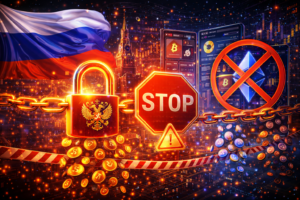
Industry experts quoted by RBC and other outlets warn that the Russian government could begin blocking access to foreign cryptocurrency exchange websites as early as this summer as part of a broader effort to align crypto trading with a new domestic regulatory regime set to roll out by July 1, 2026. The potential move would coincide with the anticipated adoption of comprehensive crypto market laws and reflect Moscow’s push to develop a licensed local ecosystem, though analysts say enforcing such restrictions could be challenging in practice.
Timing Tied to Regulatory Progress
Russia is currently drafting and preparing to implement a full regulatory framework for cryptocurrencies that is expected to be finalized for parliamentary approval by late June — with enforcement likely beginning around July 1, 2026. Under the proposed scheme, digital assets and stablecoins would be formally recognized and regulated, replacing an interim regime that previously governed crypto activity.
Experts interviewed by RBC believe that as this domestic regulatory framework takes shape, authorities could seek to limit or block access to foreign crypto exchange platforms that are not licensed in Russia. One possibility discussed is for the country’s telecom watchdog, Roskomnadzor, to adopt blocking tactics similar to those it has used on other online services, such as social media or video platforms — for example by deleting domain entries from Russia’s internal DNS system to disrupt access.
Senior analyst Nikita Zuborev of the exchange aggregator Bestchange.ru said that Russian regulators could start restricting websites of foreign exchanges this summer if those platforms do not obtain local licensing or operate through approved intermediaries.
Domestic Licensing and Market Capture
The anticipated block on unregistered platforms is part of a broader strategy to encourage the use of licensed domestic trading services. Russian authorities and financial players, including the Moscow Exchange (MOEX), have indicated readiness to offer regulated crypto products once the legal framework is in place, aiming to capture a significant portion of the estimated $15 billion in annual crypto trading fees currently paid to offshore platforms.
However, some analysts note that Russia may pursue a model similar to Belarus’s approach — where only platforms registered within a designated domestic jurisdiction (such as Belarus’s High-Tech Park) are permitted to operate. While this could provide clarity and regulatory control, experts caution that it would be difficult to fully enforce a ban on foreign trading sites, especially given existing user demand and the persistence of offshore client activity.
Challenges in Enforcement
Observers point out that blocking access alone may not stop Russian citizens from trading on unlicensed exchanges, as users could still employ tools like virtual private networks (VPNs) or other technical workarounds to reach foreign platforms — a dynamic seen previously in attempts to restrict access to social media and communication apps. Moreover, major exchanges such as Binance and Bybit have large user bases in Russia, complicating regulatory efforts focused solely on deterrence.
Legal expert Dmitry Machikhin has suggested that while a Belarus-style restriction regime is a possibility, actual enforcement may be limited, with authorities instead focusing on blocking access via technical means and pushing users toward domestic options rather than achieving a complete prohibition.
Looking Ahead
With Russia’s crypto regulatory landscape rapidly evolving, foreign platforms face pressure to adapt or risk losing access in one of the world’s larger crypto markets. How effectively domestic authorities can balance enforcement with demand — and whether barriers to foreign exchange access will significantly reshape trading behaviour — remains a key question as the July regulatory milestone approaches.
Also Check: @Fundstrat’s BitMine Buys 45,759 ETH, Bringing Its Total Holdings to ~4.37 M ETH (~$8.7 B)
966H0YIX

