
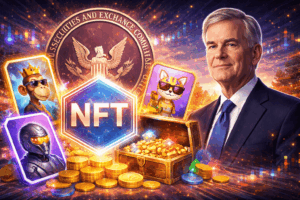
U.S. Securities and Exchange Commission (SEC) Chair Paul Atkins has clarified that most non-fungible tokens (NFTs) are not considered securities, describing them instead as digital collectibles that typically fall outside the scope of federal securities laws.
The statement is part of a broader regulatory shift aimed at providing clearer guidance for the rapidly evolving digital asset industry.
NFTs Classified as Digital Collectibles
In recent remarks, Atkins explained that NFTs are generally treated as “digital collectibles”, similar to physical items like artwork, trading cards, or memorabilia.
He noted that these assets are typically purchased for ownership rather than as part of an investment scheme, which is a key distinction under U.S. securities law.
“Assets such as baseball cards, memes, and NFTs are things people buy and hold,” Atkins said, emphasizing that they differ from traditional investment contracts.
How the SEC Determines What Is a Security
The SEC’s position is based on the long-standing Howey Test, a legal standard used to determine whether an asset qualifies as a security.
Under this framework, an asset is considered a security if it involves:
- An investment of money
- In a common enterprise
- With an expectation of profits
- Derived from the efforts of others
Atkins stated that most NFTs do not meet these criteria because they function as unique, immutable digital items, rather than instruments tied to profit expectations.
However, he cautioned that classification depends on “facts and circumstances,” meaning some NFTs could still be treated as securities if structured as investment products.
Part of Broader Crypto Classification Framework
The clarification comes alongside a new SEC framework that divides digital assets into several categories, including:
- Digital commodities
- Digital tools
- Digital collectibles (including NFTs)
- Stablecoins
These categories are generally not considered securities, while only “digital securities” — tokenized versions of traditional financial instruments — fall under SEC jurisdiction.
The framework is intended to reduce uncertainty and provide clearer boundaries for developers, investors, and regulators.
Shift Away From Enforcement-Driven Regulation
Atkins’ comments reflect a broader policy shift at the SEC toward clearer rulemaking and guidance, moving away from the agency’s previous reliance on enforcement actions to define crypto regulations.
The new approach aims to support innovation while maintaining investor protections, particularly as blockchain technology and tokenization continue to expand.
Implications for the NFT Market
The clarification could provide a boost to the NFT sector, which has faced regulatory uncertainty in recent years. By signaling that most NFTs are not securities, the SEC may reduce legal risks for:
- Digital artists and creators
- NFT marketplaces
- Blockchain-based gaming and media platforms
At the same time, experts note that projects offering NFTs with profit-sharing, staking rewards, or investment-like features could still fall under securities laws.
Outlook
The SEC’s stance marks a significant step toward defining how digital assets are regulated in the United States. While not a final rule, the guidance signals a more structured and predictable regulatory environment.
As policymakers continue refining crypto legislation, the classification of NFTs as digital collectibles may help shape the future of the digital ownership economy—while leaving room for case-by-case evaluation where financial characteristics emerge.
Also Check: UK Parliamentary Committee Urges Immediate Halt on Crypto Donations to Political Parties
2S951XEN

