
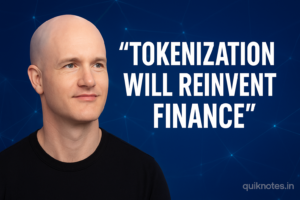
Coinbase CEO Brian Armstrong recently said that tokenization is set to “reinvent finance,” arguing that any asset that can be tokenized will be — and that tokenized assets will deliver significant benefits for end users, such as 24/7 trading access, instant settlement, and greater financial inclusion.
What Armstrong said — and why it matters
- On November 6, 2025, Armstrong stated that “trading hours and markets that close are outdated,” and said that tokenized assets — which can trade 24/7 with instant settlement — will be “much better for the end user.”
- He envisions a future in which all kinds of assets — from traditional securities to real-world assets (RWA), startups, and global markets — could be tokenized and moved on-chain.
- According to Armstrong, this shift could bring major efficiencies for capital formation, trading and access: building startup lifecycles on-chain, enabling faster, cheaper, and more inclusive financial services.
In his words, tokenization isn’t just a new product category — it could transform the way financial markets operate globally.
How Coinbase is positioning itself for a tokenized future
- Coinbase is working to evolve beyond a pure cryptocurrency exchange toward what it’s calling a “universal exchange,” aiming to support a wide range of tokenized assets — including equities, real-world assets, derivatives, and more — on blockchain rails.
- The company recently acquired a token-sales platform (Echo) to facilitate on-chain fundraising and token offerings. Coinbase plans to expand this into tokenized equity and real-world-asset markets over time.
- The aim: to provide users a unified, on-chain financial hub — where creating, trading, and managing assets is decentralized, fast, and globally accessible.
Broader context — why tokenization is gaining momentum
Tokenization — the process of converting assets (stocks, real-world assets, funds, etc.) into blockchain-based digital tokens — is increasingly seen as a way to:
- Enable fractional ownership and broader access to assets that were previously illiquid or fragmented.
- Provide faster settlement and 24/7 trading, removing limitations imposed by traditional market hours or geographic restrictions.
- Reduce friction in capital formation (fundraising, IPOs, equity issuance), particularly for startups and smaller firms — democratizing access to investing and liquidity.
- Potentially reshape global finance by combining the transparency, efficiency, and decentralization of blockchain with traditional asset value.
Industry commentary increasingly frames tokenization as the next wave in finance — one that could blur lines between traditional finance (TradFi) and decentralized finance (DeFi), if regulatory and institutional frameworks align.
Challenges & what remains uncertain
While tokenization holds promise, there are hurdles and open questions:
- Regulatory uncertainty: Some regulators have emphasized that tokenized securities remain subject to existing securities laws — tokenization does not eliminate compliance or oversight requirements.
- Liquidity and market structure: Creating a token is one thing; ensuring sufficient liquidity, fair trading, custody, clearing, and compliance is harder — especially for real-world assets or tokenized equities.
- Adaption by traditional institutions: For tokenized assets to realize their potential, buy-in from regulators, financial institutions, and asset issuers is required — a transition that may take years.
- User protection and transparency: As with all crypto — tokenized assets must come with clear disclosure, custody safeguards, and protections against misuse or fraud.
What to watch next
- Whether Coinbase — or other major exchanges — obtain regulatory approval to list tokenized equities or real-world-asset tokens.
- How regulators respond globally: whether they embrace tokenization under existing frameworks, or introduce new laws/regulations for digital-asset securities.
- Adoption by startups and traditional firms: whether new companies begin raising capital on-chain, or if legacy firms tokenize existing assets.
- Market infrastructure development: liquidity pools, decentralized exchanges, custody solutions, compliance tools — all needed to make tokenization viable at scale.
- Real-world use cases: fractionalized real estate, tokenized funds, global cross-border asset trading, 24/7 markets that challenge traditional trading hours.
Conclusion
Brian Armstrong’s recent remarks — that “tokenization will reinvent finance” and that “everything that can be tokenized, will be” — reflect a bold vision for the future of global finance. As Coinbase pivots toward becoming a universal on-chain exchange, the notion of tokenized assets trading 24/7 with instant settlement is shifting from theory to actionable roadmap.
If tokenization delivers on its promise — greater access, speed, transparency, and financial inclusion — it could mark a major turning point in how we raise capital, trade assets, and invest. But realizing that future will require careful coordination between innovators, regulators, asset issuers, and the broader financial ecosystem.
Also Check: Citadel Securities Urges SEC to Regulate DeFi Tokenized Stocks Like Traditional Markets
XE133WU0

