
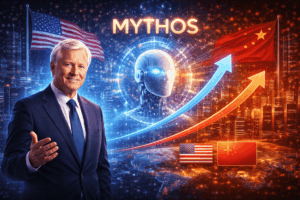
U.S. Treasury Secretary Scott Bessent has described Mythos, a new artificial intelligence system developed by Anthropic, as a major technological breakthrough that could help the United States maintain its competitive edge over China in the global AI race.
Speaking during a recent policy discussion, Bessent stated that the U.S. currently holds a three- to six-month lead over China in advanced AI development, underscoring the strategic importance of continued innovation and investment.
AI Race Between U.S. and China Intensifies
Bessent’s remarks highlight growing geopolitical competition in artificial intelligence, which has become a key battleground for economic and national security leadership.
“The United States remains ahead, but the margin is narrow,” Bessent said, emphasizing that breakthroughs like Mythos are critical to sustaining that advantage.
Industry experts widely agree that the AI race between the U.S. and China is accelerating, with both countries investing heavily in infrastructure, talent, and advanced computing capabilities.
Anthropic’s Mythos Gains Attention
The AI model Mythos has drawn significant interest within the tech and policy communities for its reported advancements in reasoning, safety alignment, and large-scale data processing.
Anthropic, known for its focus on AI safety and responsible development, has positioned Mythos as a next-generation system capable of handling complex analytical and decision-making tasks.
While full technical details remain limited, early reactions suggest the model could represent a meaningful step forward in enterprise and government AI applications.
Strategic Importance of AI Leadership
Bessent stressed that maintaining leadership in AI is essential not only for economic growth but also for national security and global influence.
He noted that AI technologies are increasingly integrated into:
- Defense and intelligence systems
- Financial markets and economic forecasting
- Critical infrastructure and cybersecurity
As a result, even small technological leads can have outsized strategic implications.
Policy and Investment Push
The U.S. government has been ramping up efforts to support AI development through funding initiatives, public-private partnerships, and regulatory frameworks designed to encourage innovation while managing risks.
Officials have also emphasized the importance of semiconductor supply chains, cloud infrastructure, and talent development in maintaining a competitive edge.
At the same time, export controls and restrictions on advanced chips have been used to limit China’s access to critical AI technologies.
Challenges Ahead
Despite the optimistic outlook, experts caution that the AI race remains highly dynamic.
Key challenges include:
- Rapid advancements by Chinese tech firms
- Increasing costs of training advanced AI models
- Ethical and regulatory concerns around deployment
- Talent shortages in highly specialized AI fields
Bessent acknowledged these challenges, warning that the U.S. lead could quickly narrow without sustained effort.
Outlook
The recognition of Mythos as a breakthrough underscores the pace of innovation in artificial intelligence and its growing role in global competition.
As governments and companies race to develop more advanced systems, the coming months could prove decisive in shaping the future balance of power in AI.
For now, U.S. officials remain cautiously optimistic—pointing to innovations like Mythos as evidence that the country is still at the forefront of the AI revolution.
Disclaimer: This article is for informational purposes only and does not constitute financial or investment advice.
Also Check: Crypto ETF Flows Diverge on April 13 as Bitcoin Sees Outflows While Ethereum and XRP Record Gains
RONEUXBO

