
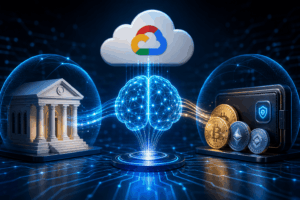
Crypto banking firm Anchorage Digital and Google Cloud have unveiled a new “Agentic Banking” platform, a system designed to allow artificial intelligence (AI) agents to autonomously access, manage, and transfer funds across both traditional finance and crypto networks.
The initiative marks a significant step toward what industry leaders are calling the “agentic economy,” where AI systems can independently execute financial transactions without direct human intervention.
A New Layer for Autonomous Finance
According to company announcements, Agentic Banking introduces a regulated infrastructure that enables AI agents to interact with capital in a secure and compliant way. Anchorage Digital said the platform acts as a trust, governance, and settlement layer, allowing institutions to deploy AI agents that can execute payments, manage treasury operations, and perform financial workflows autonomously.
The system enforces corporate policies, identity verification, and real-time compliance checks before any transaction is executed—whether across fiat rails, stablecoins, or tokenized assets.
Bridging AI Intelligence With Real Money
The partnership integrates Google Cloud’s AI capabilities—including advanced reasoning models and secure key management—with Anchorage’s regulated crypto banking infrastructure.
This combination is intended to solve a critical gap in AI adoption: enabling intelligent systems not just to analyze or recommend actions, but to execute real-world financial decisions.
“Agents don’t just inform decisions, they make them—and act on them,” said Anchorage CEO Nathan McCauley, describing the platform as a bridge between AI intelligence and financial execution.
From Assistants to Autonomous Agents
The launch aligns with a broader industry shift toward “agentic AI,” where systems move beyond passive assistance to active participation in business operations.
Recent developments across the tech sector show enterprises increasingly deploying AI agents capable of reasoning, coordinating, and executing complex tasks independently.
Agentic Banking extends this concept into finance, enabling AI systems to:
- Execute transactions and payments
- Manage digital asset portfolios
- Interact with both crypto and traditional banking rails
- Operate continuously without human input
Institutional Focus and Compliance
A key differentiator of the platform is its regulatory foundation. Anchorage Digital—the first federally chartered crypto bank in the U.S.—positions Agentic Banking as a compliant solution for institutions adopting AI-driven financial automation.
The platform includes:
- Policy-based spending controls
- Audit trails for all agent actions
- Identity frameworks for AI agents
- Real-time compliance enforcement
These features aim to address concerns around security, accountability, and governance in autonomous financial systems.
Powering the Emerging ‘Agentic Economy’
Industry analysts suggest the move could accelerate the development of a new economic model where AI agents transact with each other, businesses, and financial systems at scale.
Anchorage has indicated that this “agentic economy” could grow into a trillion-dollar opportunity, driven by autonomous systems handling commerce and payments.
The infrastructure built with Google Cloud is designed to support this future by offering scalable, cloud-native tools for deploying and managing AI-driven financial operations.
Challenges and Risks Ahead
Despite the promise, the rise of autonomous financial agents introduces new challenges. Experts point to concerns around:
- Security vulnerabilities in AI decision-making
- Regulatory oversight of autonomous transactions
- Risk management and accountability
Ensuring that AI agents operate within strict governance frameworks will be critical as adoption grows.
Conclusion
The launch of Agentic Banking by Anchorage Digital and Google Cloud signals a major evolution in financial technology—one where AI systems are not just tools, but active economic participants.
As the boundaries between artificial intelligence and financial infrastructure continue to blur, the success of such platforms may determine how quickly the global economy transitions into an AI-driven, autonomous future.
Also Check: Ripple CEO Warns US Crypto Bill Faces Two-Week Deadline as Passage Odds Dim
QJ2ORT69

