
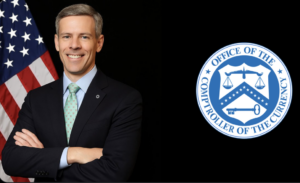
The U.S. Comptroller of the Currency, Jonathan V. Gould, said crypto companies that apply for federal bank or trust charters should be evaluated on the same standards as traditional banks, pushing back on industry resistance that would treat digital-asset firms differently. Gould made the comments in public testimony and at industry events this fall as several high-profile crypto firms pursue OCC charters.
Key facts
- Gould told lawmakers and attendees at recent industry gatherings that there is “no justification” for treating crypto firms differently from other financial firms when they seek federal charters, noting that applications should be judged by law, risk-management capability and the applicant’s business model.
- The OCC has received multiple charter applications or filings from crypto companies in 2024–25, including trust- or national-charter bids from major industry players. Those bids have drawn scrutiny from banks and some lawmakers.
- The Comptroller’s office has issued guidance and statements this year clarifying permissible crypto activities for national banks and outlining areas of supervisory focus, part of a broader regulatory shift that seeks to bring crypto activity into supervised channels rather than pushing it offshore or into unregulated corners.
What Gould said and where
Gould set out the position both in written testimony to the House Financial Services Committee on December 2, 2025and in public remarks to industry groups. In the testimony he emphasized that charter decisions should be grounded in law and supervisory standards rather than sectoral prejudice, and that longstanding charter categories — such as trust charters — can encompass certain crypto business models when applicants meet regulatory requirements.
Why the comments matter
Gould’s stance matters for three main reasons:
- Access to regulated plumbing. A federal charter gives firms certain access to the U.S. banking system and payments infrastructure — and with it, potential resilience and legitimacy for services such as custody or stablecoin operations. That access is a central motivation behind several recent charter applications.
- Level playing field vs. risk concerns. Banks and some industry groups have pushed back, warning that some crypto business models pose unique operational or conduct risks that warrant extra scrutiny. Gould’s remarks signal the OCC’s intent to apply existing supervisory tools and legal frameworks rather than adopt a blanket exclusion.
- Regulatory integration rather than prohibition. By treating charter-seeking crypto firms “no differently” in principle, the OCC is leaning toward integrating crypto into the regulated banking system when firms demonstrate adequate controls — a position aligned with recent steps by other U.S. regulators to clarify how banks may engage with crypto.
Industry reaction
Supporters of charters — including some crypto firms and fintech advocates — welcomed Gould’s comments as a pragmatic path to onshoreing activity and reducing fragmentation. Critics, including several banking trade groups and some members of Congress, warned that charters should not be a shortcut around careful vetting and that supervisors must remain vigilant about consumer protection, anti-money-laundering (AML) controls and operational resilience. Media coverage has reflected this split: reporting shows both momentum behind charter applications and persistent political and industry scrutiny.
Legal and supervisory context
The OCC’s authority to issue national bank and trust charters is well established; past interpretive letters and OCC guidance have outlined when banks may custody digital assets or participate in distributed-ledger networks. Gould’s recent testimony reiterates that the OCC will apply existing legal standards to novel business models, and that supervisory expectations (capital, liquidity, AML, operational resilience) remain central to any approval.
Caveats and outlook
- No automatic approvals. Gould’s comments do not mean charters will be granted automatically — each application will still face a facts-and-law assessment, and some applications may be denied or withdrawn.
- Political and interagency dynamics. Congress, the Department of the Treasury and other regulators remain active on digital-asset policy; legislation or interagency positions could change the practical landscape for charters.
- Market and operational risks. Supervisors will be watching for robust AML controls, custody protections, reserves and operational safeguards if firms are granted bank-like privileges. That scrutiny may shape the speed and scope of future approvals.
Bottom line
Jonathan Gould’s public insistence that crypto firms seeking federal charters be treated similarly to banks signals the OCC’s preference for regulated on-ramps rather than blanket exclusion. The position could accelerate efforts by major crypto firms to secure U.S. charters — but approvals will continue to depend on rigorous, application-specific supervisory review and broader political developments.
TPCQ0ASI

