
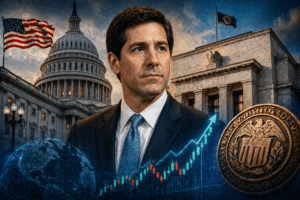
The U.S. Senate Banking Committee has voted 13–11 to advance the nomination of Kevin Warsh as the next chair of the Federal Reserve, clearing a critical hurdle in the confirmation process.
The party-line vote sends Warsh’s nomination to the full Senate, where he is widely expected to secure confirmation and succeed Jerome Powell, whose term ends in mid-May.
Key Highlights
- Senate Banking Committee approved Warsh’s nomination 13–11 along party lines
- Moves nomination to full Senate for final confirmation vote
- Warsh expected to succeed Jerome Powell as Fed chair
- Vote follows resolution of a Justice Department probe tied to Powell
- Democrats raise concerns over Fed independence and political influence
Key Step Toward Federal Reserve Leadership
The committee’s approval marks one of the most important stages in the appointment process for a Federal Reserve chair. With Republicans backing the nominee and holding a Senate majority, Warsh’s confirmation is considered highly likely.
Warsh, a former Fed governor and Wall Street executive, has been nominated to lead the central bank at a time of ongoing economic uncertainty, including inflation concerns and geopolitical pressures.
Political Dynamics Behind the Vote
The 13–11 outcome reflected a strict party divide, with all Republicans voting in favor and all Democrats opposing the nomination.
The vote was previously uncertain due to opposition from Republican Senator Thom Tillis, who had blocked progress over a Justice Department investigation involving Powell. However, the probe was recently dropped, clearing the path for the committee vote.
Debate Over Fed Independence
Warsh’s nomination has sparked significant debate in Washington, particularly regarding the independence of the Federal Reserve.
Democratic lawmakers, including Senator Elizabeth Warren, have expressed concerns that Warsh could be influenced by political pressures, especially given his ties to former President Donald Trump.
Warsh has pushed back on these claims, stating that he would act independently if confirmed and emphasizing the importance of maintaining the Fed’s credibility.
Policy Outlook and Potential Changes
During his confirmation process, Warsh signaled that he may pursue changes in how the Federal Reserve operates. His proposals reportedly include:
- Reducing the Fed’s balance sheet
- Revising communication strategies
- Reevaluating monetary policy frameworks
He has also criticized past central bank actions, particularly pandemic-era stimulus measures, which he argues contributed to inflation.
What Happens Next?
With committee approval secured, the nomination now moves to the full Senate for a confirmation vote. If confirmed, Warsh could assume the role before or shortly after Powell’s term expires on May 15.
The transition would come at a pivotal time for U.S. monetary policy, as the Federal Reserve navigates inflation control, interest rate decisions, and global economic uncertainty.
Conclusion
The Senate Banking Committee’s 13–11 vote marks a decisive step toward installing Kevin Warsh as the next Federal Reserve chair. While his confirmation appears likely, the debate surrounding his nomination highlights ongoing tensions over the independence and future direction of the U.S. central bank.
51NJ5RIK

