
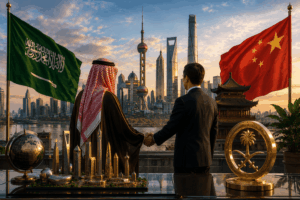
Saudi Arabia’s Public Investment Fund (PIF), the kingdom’s sovereign wealth fund valued at nearly $1 trillion, has expanded its presence in mainland China by opening a new office in Shanghai, deepening investment and economic ties between Riyadh and Beijing.
The Shanghai office becomes PIF’s second mainland China location after Beijing and reflects Saudi Arabia’s growing focus on Asia as part of its long-term economic diversification strategy under Vision 2030.
PIF Opens Shanghai Office to Boost China Dealmaking
According to reports from Bloomberg and other financial media outlets, the Shanghai office began operations earlier in 2026 and operates under PIF’s Beijing branch, which is led by Lily Cong, a former Fidelity International executive in China.
Sources familiar with the matter said the new office was established to:
- Expand outbound investment deals in China
- Strengthen partnerships with Chinese firms
- Attract Chinese investment into Saudi Arabia
- Support Saudi industrial and technology initiatives
Representatives for PIF have not publicly commented on the expansion.
Saudi Arabia Deepens Strategic Ties With China
The move underscores Saudi Arabia’s increasingly close economic relationship with China, which has become one of the kingdom’s most important trading and investment partners.
Saudi Arabia and China have expanded cooperation across sectors including:
- Energy
- Infrastructure
- Artificial intelligence
- Manufacturing
- Finance
- Technology and smart cities
Analysts say the Shanghai office signals Riyadh’s intention to strengthen its role within Asia’s financial and industrial ecosystem while reducing overreliance on Western markets.
Vision 2030 Driving Overseas Investment Strategy
PIF is the primary financial engine behind Crown Prince Mohammed bin Salman’s Vision 2030 program, which aims to diversify Saudi Arabia’s economy away from oil dependence.
The sovereign wealth fund has invested heavily in sectors such as:
- Clean energy
- Technology
- Gaming
- Electric vehicles
- Logistics
- Tourism and mega-city projects
PIF’s overseas investment strategy has increasingly shifted toward strategic partnerships capable of supporting domestic industrial development inside Saudi Arabia.
The fund has previously partnered with Chinese companies through projects involving manufacturing, electronics, and smart infrastructure initiatives.
Why Shanghai Matters
Shanghai is widely considered China’s financial capital and a major gateway for global investment, technology, and industrial partnerships.
By expanding into Shanghai, PIF gains closer access to:
- Chinese capital markets
- Manufacturing supply chains
- High-tech firms
- Venture capital and industrial investors
The city also provides stronger connectivity to companies involved in sectors critical to Saudi Arabia’s modernization plans, including semiconductors, robotics, artificial intelligence, and advanced manufacturing.
Gulf Sovereign Funds Increasing Focus on Asia
PIF’s expansion mirrors a broader trend among Middle Eastern sovereign wealth funds increasing exposure to Asian markets.
Reports indicate that Abu Dhabi-based investment funds are also reviewing strategies to expand and consolidate China-focused investments amid shifting geopolitical and economic conditions.
Regional tensions, energy market volatility, and growing U.S.-China competition have accelerated Gulf nations’ efforts to diversify partnerships and build stronger economic relationships across Asia.
Balancing Domestic and International Investments
Despite expanding internationally, PIF has recently indicated that a larger share of its capital will remain focused on domestic Saudi projects tied to Vision 2030.
Recent reports suggest the fund may reduce the proportion of its international portfolio allocations while prioritizing sustainable domestic growth and strategic investments.
However, China remains a priority market because of its manufacturing strength, infrastructure expertise, and growing role in global trade.
Global Implications
The expansion highlights the continuing shift in global investment dynamics as Gulf sovereign wealth funds increasingly align with Asian economic centers.
Experts say stronger Saudi-China financial integration could:
- Increase Chinese investment in the Middle East
- Accelerate yuan-based trade discussions
- Expand industrial cooperation between both countries
- Strengthen China’s role in Gulf economic transformation
The move also reflects broader geopolitical changes as Gulf nations pursue more diversified economic and diplomatic partnerships beyond traditional Western alliances.
Conclusion
Saudi Arabia’s decision to expand PIF’s mainland China operations with a new Shanghai office marks another major step in the kingdom’s deepening relationship with Beijing.
As Riyadh pushes forward with Vision 2030 and China continues expanding its global economic influence, the growing partnership between the two nations is likely to play an increasingly important role in shaping investment flows, trade, and geopolitical strategy across the Middle East and Asia.
7SRREVTC

