
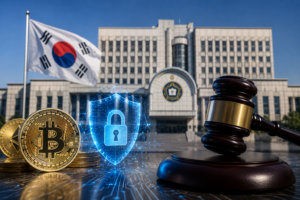
South Korea’s Supreme Court has unveiled proposed amendments to the country’s Civil Execution Rules that would establish a comprehensive legal framework for the seizure and liquidation of cryptocurrencies in civil proceedings.
The proposal marks another significant step in South Korea’s evolving digital asset regulatory landscape, providing courts with standardized procedures for freezing, managing, and selling cryptocurrencies when enforcing civil judgments. The draft rules are open for public consultation until August 11, with implementation expected on October 1, if adopted.
New Rules Aim to Standardize Crypto Enforcement
The proposed amendments are designed to eliminate legal uncertainty surrounding the enforcement of judgments involving digital assets.
Under the draft rules, courts would be able to seize not only cryptocurrencies themselves but also a debtor’s legal right to demand the transfer of virtual assets held by cryptocurrency exchanges or other custodians. Once a seizure order takes effect, the debtor would be prohibited from transferring or disposing of the affected assets.
Court-appointed enforcement officers would work directly with virtual asset service providers (VASPs) to secure the digital assets before liquidation.
Multiple Options for Liquidating Seized Crypto
Recognizing the unique nature of digital assets, the Supreme Court has proposed several methods for converting seized cryptocurrencies into cash.
Depending on the circumstances, courts could:
- Order the direct transfer of cryptocurrencies to creditors.
- Authorize the sale of digital assets through licensed virtual asset service providers.
- Transfer seized assets into an enforcement officer’s account for liquidation.
- Convert illiquid or low-volume cryptocurrencies into more actively traded digital assets, such as Bitcoin, before selling them.
The flexibility is intended to maximize the value recovered during court-supervised enforcement while minimizing market disruption.
Building on Earlier Supreme Court Decisions
The latest proposal follows a landmark Supreme Court ruling issued earlier this year that confirmed cryptocurrencies held on domestic exchanges qualify as property subject to seizure under South Korea’s Criminal Procedure Act.
That decision resolved years of legal uncertainty by determining that Bitcoin and other virtual assets possess economic value and therefore can be confiscated during criminal investigations.
The newly proposed Civil Execution Rules extend similar legal clarity to civil litigation, where creditors previously lacked standardized procedures for recovering digital assets through court orders.
Greater Legal Certainty for Creditors
Legal experts believe the proposed framework will strengthen creditor protections while improving consistency across South Korea’s judicial system.
For the first time, courts would have explicit procedures governing:
- Freezing cryptocurrency wallets.
- Coordinating with exchanges holding customer assets.
- Preventing unauthorized transfers after seizure.
- Selling or converting seized virtual assets.
- Distributing proceeds to creditors following liquidation.
The framework is expected to reduce disputes over enforcement while aligning crypto asset recovery with existing procedures used for other financial assets.
Public Consultation Underway
The Supreme Court’s Administrative Office has opened the proposed amendments for public comment until August 11, allowing industry participants, legal professionals, exchanges, and citizens to submit feedback before the rules are finalized.
If adopted as scheduled, the revised Civil Execution Rules would take effect on October 1, creating one of the world’s most detailed judicial frameworks for handling cryptocurrencies during civil enforcement proceedings.
Part of South Korea’s Broader Crypto Regulatory Push
The proposed court rules arrive as South Korea continues expanding its regulatory framework for digital assets.
In recent months, policymakers have introduced legislation covering stablecoins, tokenized securities, investor protections, and virtual asset service providers. The judiciary’s latest initiative complements those efforts by ensuring courts have modern enforcement tools capable of handling increasingly common disputes involving cryptocurrencies.
Market Impact
While the proposal primarily targets civil enforcement rather than cryptocurrency trading, it signals South Korea’s continued commitment to integrating digital assets into its legal and financial systems.
For creditors, exchanges, and institutional investors, the rules promise greater legal certainty when recovering digital assets through court proceedings. For the broader crypto industry, the initiative reinforces South Korea’s position as one of the world’s most active jurisdictions in developing comprehensive legal standards for digital assets.
Also Check: Major County Sheriffs Drop Opposition to CLARITY Act, Boosting Senate Prospects
VPXWHRIU

